Fiber Cement Siding Installation in Hallandale Beach, FL
Fiber cement siding installation in Hallandale Beach, FL gives a frame wall a cladding that will not rot, burn or feed termites. It is heavy, precise work, and the details behind each board decide how well it holds up to salt air and hurricane winds.
Fiber cement is made mostly of cement, sand and cellulose fibres, pressed into planks, panels and shingles that look like painted wood. It does not swell like wood, it gives termites nothing to eat and it will not catch fire. Those qualities make it the siding many South Florida owners pick for an addition, a second storey or a wall that has already lost one round of wood siding to rot.
It is also a demanding material to install. The boards are heavy and brittle until they are fastened, the cutting dust has to be controlled, and the manufacturers publish strict rules on clearances, joints and fasteners. This page explains what goes wrong when those rules are ignored, how the work is done properly, what it typically costs and how a project runs. For the bigger picture, see siding installation in general, or compare it with vinyl siding. You can always return to PrimeCrest Exteriors' homepage for Hallandale Beach siding work as well.
Fiber cement on Hallandale Beach homes
Close to the ocean, the board is rarely what fails first. The salt carried on the sea breeze attacks plain steel nails, bare aluminium and uncoated flashing, and a rusted fastener can let a plank loosen or leave a streak down a fresh paint job. That is why a Hallandale Beach fiber cement siding installation is usually specified with stainless steel or other corrosion-resistant fasteners the manufacturer allows for coastal exposure.
Rain is the other local factor. Afternoon storms in summer drive water sideways into every unflashed joint, and humid air keeps it there. Fiber cement handles wet weather well when its edges are protected and the boards are kept up off roofs, decks and the ground. The wind code matters too: Broward County is in the high-velocity hurricane zone, so the fiber cement product needs an approval for that zone and every board is fastened to the schedule the approval sets out.
Common Problems That Call for Fiber Cement Siding
Requests for fiber cement siding installation in Hallandale Beach usually follow a wood, plywood or vinyl wall that let its owner down. The trouble is that a careless fiber cement job creates problems of its own, so both sides are worth knowing.
Signs fiber cement is worth considering
- Wood siding or trim with soft spots, hollow sections or termite mud tubes.
- Plywood or hardboard panels that swell at the bottom edge and never hold paint.
- Vinyl that has warped in the sun or cracked after a storm, on a wall you want to last longer.
- A new addition where you want the look of painted wood without the upkeep.
- A wall close to a neighbour's house where a noncombustible cladding is appealing.
What goes wrong on badly installed fiber cement
Most failures trace back to installation, not the product. Boards run down onto a roof or into mulch soak up water at their bottom edges and start to flake. Butt joints left without flashing behind them let rain straight through to the sheathing. Nails driven too hard crack the face or break through it, and plain steel nails rust in coastal air. Field-cut ends that were never sealed absorb moisture and swell. Each of these can look fine on the day the job ends and show up a year or two later.
Repair the install or start over?
A few cracked boards or a missing kick-out flashing can usually be fixed by replacing those pieces and correcting the detail. When the clearances are wrong along a whole roof line, joints were never flashed or the wrong fasteners were used throughout, the faults repeat on every course, and taking that wall back to the water barrier is often the honest answer.
What Does Fiber Cement Siding Installation Involve?
A good fiber cement siding installation in Hallandale Beach is mostly a matter of following the manufacturer's instructions and the product approval to the letter. These are the stages that make the difference.
Checking the wall and the approval
The framing has to be flat and solid enough to carry a heavy cladding, so it is checked before anything is ordered. We also pull the product's approval for the high-velocity hurricane zone and read its fastening schedule, because that document decides nail type, length and spacing on your walls.
Delivery and storage
Fiber cement is stored flat, off the ground and under cover until it goes up. Boards that sit in the rain or bow over an uneven stack can be damaged or carry moisture into the wall. Two people carry long planks on edge so they do not snap under their own weight.
Cutting safely
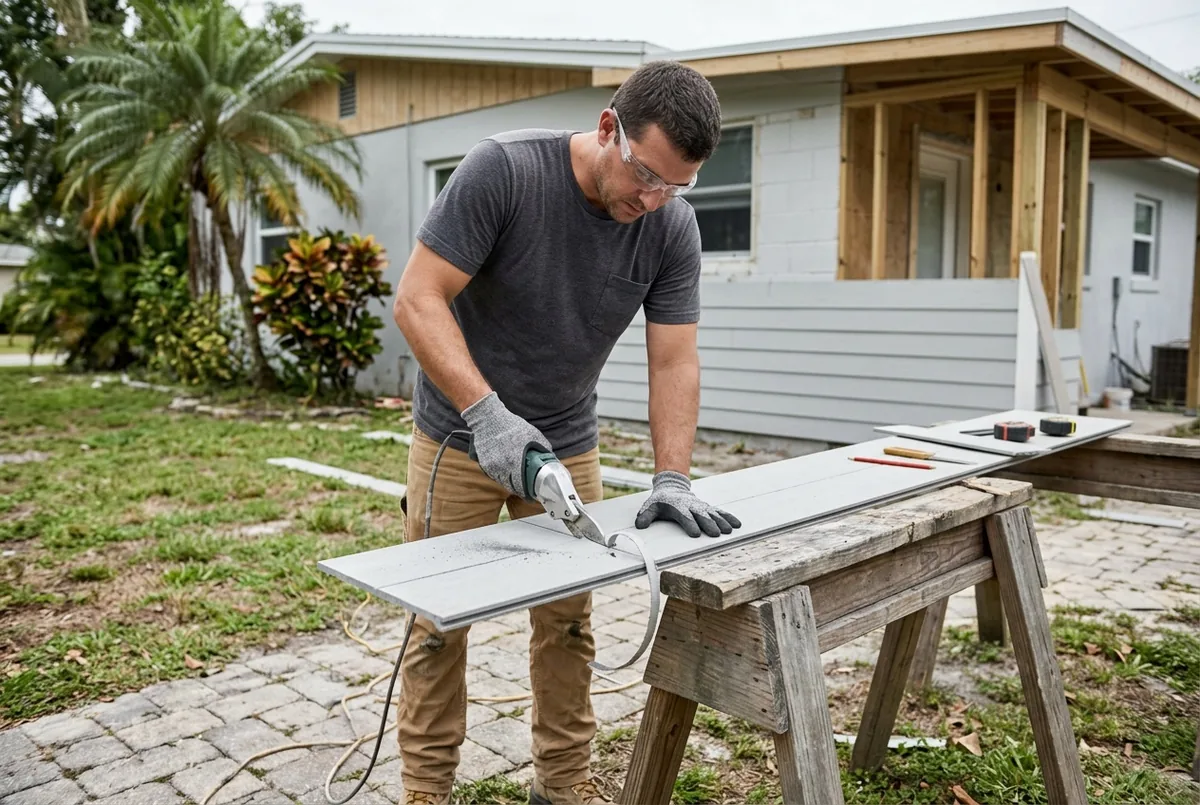
Cutting fiber cement releases crystalline silica dust, which federal workplace rules require contractors to control. Boards are cut outdoors with shears or a saw fitted with dust collection, and the cutting station is set up away from open windows and doors, so the dust stays out of your house.
Clearances and flashing
The manufacturers call for set gaps: several inches above finished grade, a gap above roof surfaces and a small gap above horizontal flashing, so bottom edges never sit in water. Butt joints get a flashing strip behind them, windows are flashed into the water barrier and every roof-to-wall line gets a kick-out.
Fastening and sealing
Planks are lapped and fastened with corrosion-resistant nails or screws, driven snug to the face but never countersunk. Whether boards are blind-nailed or face-nailed, and at what spacing, comes from the approval. Every cut end is sealed or touched up before the trim covers it.
What to expect at home
Fiber cement jobs take a little longer than vinyl because of the weight and the care each cut needs. Expect a cutting area set up in the yard, scaffolding on taller walls and a final paint stage if you chose primed boards. Keep cars clear of the cutting station and close windows on that side of the house.
How Much Does Fiber Cement Siding Installation Cost?
Fiber cement sits at the upper end of siding costs because the material weighs more, takes longer to cut and fasten and often needs paint. The national figures below show what typical projects run before your walls have been measured.
| What | National range |
|---|---|
| Typical fiber cement siding project | $8,000–$26,600 per project |
| Fiber cement siding, installed | $5–$14 per square foot |
What changes the price
Square footage comes first. Plank, panel and shingle profiles cost different amounts, and factory-finished boards cost more up front than primed boards but skip the separate paint stage. Second storeys and gables add scaffolding. Every window, door and outside corner adds trim and flashing labour, and stainless steel fasteners, permit fees and a tight hurricane-zone fastening schedule all show up on the estimate.
These are national ranges, not a quote. The final cost of fiber cement siding installation in Hallandale Beach depends on your walls and the product line you pick, and it is set by an estimate after an inspection.
Why Choose PrimeCrest Exteriors Siding Contractor?
We are a siding company and nothing else, based in Hallandale Beach and installing siding since 2015. That focus shows on fiber cement, a material that punishes shortcuts: the gap above a roof line, the flashing strip behind each joint and the sealed cut end are the things we check on every wall before we call it done.
Your estimate names the product, the profile, the fastener type and the trim and flashing work, so you can compare it line by line with any other bid. We keep you posted as the job moves and ask before changing anything. Our phones are answered every day from 7am to 10pm, and we are on call 24/7 for emergencies such as storm damage.
Our Fiber Cement Siding Installation Process
Fiber cement rewards a careful sequence. Every Hallandale Beach fiber cement siding installation we handle follows these six steps, taking a wall from bare sheathing to finished cladding without leaving it exposed longer than it has to be.
First conversation
Call (786) 833-8892 or use the form to describe the walls, the look you want and your timeline.
Inspection and approval check
We inspect the framing and sheathing and confirm which fiber cement products are approved for the hurricane zone.
Profile, finish and estimate
You choose plank, panel or shingle and primed or factory finish, then get a written scope and price.
Permit, delivery and setup
Paperwork goes in where required, boards are delivered and stored flat and dry, and a dust-controlled cutting area is set up.
Barrier, flashing and boards
The water barrier and flashing go on, then each course is cut, sealed and fastened with the right clearances.
Finish and final check
Primed boards are painted, the site is cleaned, and we walk every wall with you to check joints, gaps and trim.
Frequently Asked Questions About Fiber Cement Siding Installation
Is fiber cement siding good for a house near the ocean?
Yes, as long as the fasteners and flashing are chosen for salt air. The boards themselves do not rust, rot or feed termites. The weak points near the coast are plain steel nails and uncoated metal trim, so stainless steel fasteners are a sensible choice on a house close to the water. That makes fastener choice one of the first questions on any fiber cement siding installation in Hallandale Beach, since the whole city lies between the beach and the Intracoastal Waterway.
How much does fiber cement siding installation in Hallandale Beach cost?
National research puts a typical fiber cement project at $8,000–$26,600, or about $5–$14 per square foot installed. Your price depends on wall area, height, trim and the product line, so it is set by an estimate after the walls are measured.
Does fiber cement siding need to be painted?
Primed boards need paint after they are installed, while factory-finished boards arrive with their colour already baked on. Either way, the field-cut ends are sealed or touched up as the manufacturer directs, because an unsealed edge is where moisture gets in.
Can fiber cement siding stand up to a hurricane?
It can when the product is approved for the high-velocity hurricane zone and fastened exactly to that approval. The wind resistance comes from the fastener type, length and spacing as much as from the board, which is why the approval document is followed line by line.
Is cutting fiber cement dangerous?
The dust is the hazard, because it contains crystalline silica. Federal workplace rules require dust controls when it is cut, so boards are cut outdoors with shears or a saw fitted with dust collection, and the work area is kept clean rather than swept dry.
How long does fiber cement siding last?
Fiber cement is one of the most durable sidings available. In practice its life depends on the installation: clearances kept, joints flashed, edges sealed and paint maintained. A board kept dry at its edges simply has little that can fail.
Request Fiber Cement Siding Installation in Hallandale Beach
Ready to talk boards, profiles and finishes? Call PrimeCrest Exteriors Siding Contractor about fiber cement siding installation in Hallandale Beach. Open every day from 7am to 10pm, and on call 24/7 for emergencies.