
Siding Installation in Hallandale Beach, FL
Siding installation in Hallandale Beach, FL puts a new exterior on walls that are being built or rebuilt: a frame addition, a second storey over a block house, a garage conversion or a new home. The material, the water barrier and the fastening all have to suit a coastal hurricane zone.
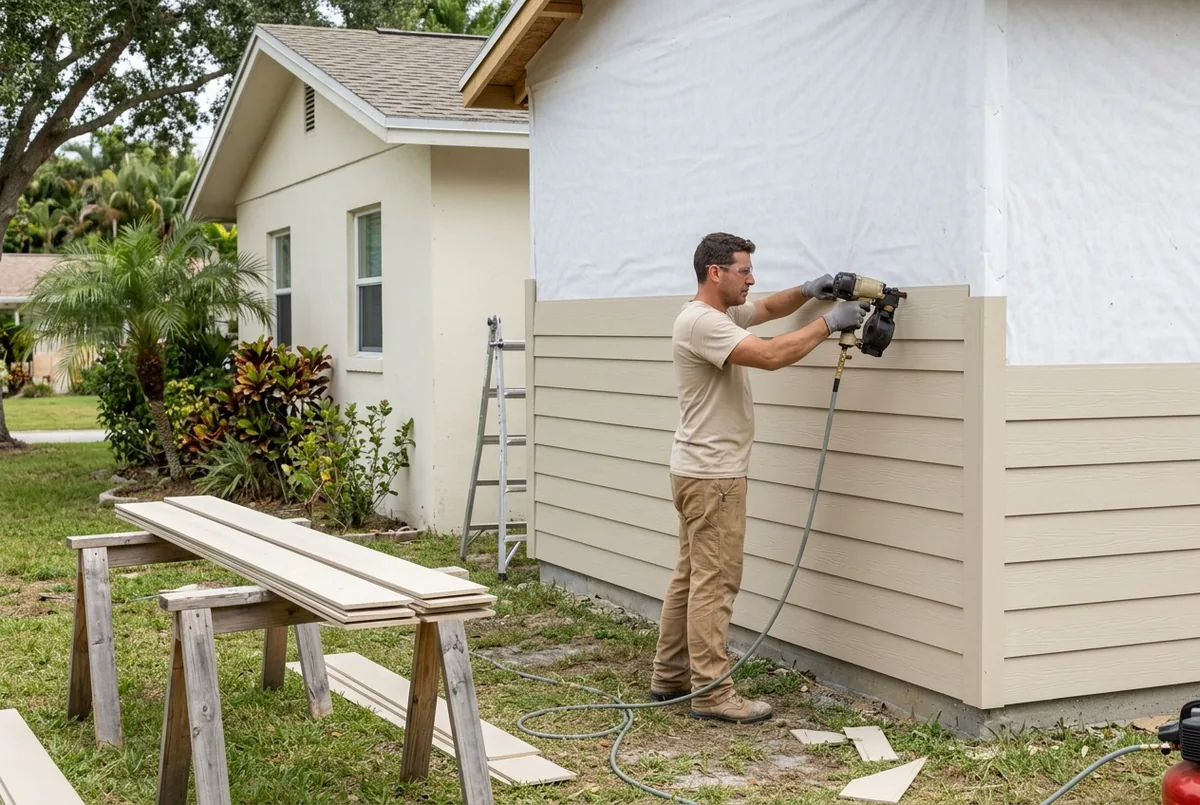
Siding is the last layer of a wall and the only one anybody sees. What decides whether it lasts is everything under it: sheathing that is flat and dry, a water-resistive barrier lapped so water runs out, flashing at every opening, and fasteners that will not rust in salt air. Get those right and the siding sheds rain for a very long time. Skip them and even the best board on the market lets water into the framing.
This page covers installing siding where there is none yet, or where a wall has been stripped back to its studs or sheathing. It explains the problems new siding solves, what the work involves, typical national costs and how a job runs from the first call to the final walk-through. If you already know which material you want, the pages on fiber cement siding and vinyl siding go into more detail. If your existing siding is failing, siding replacement explains tear-off and wall repair. You can also start from PrimeCrest Exteriors Siding Contractor's main page for an overview of everything we handle.
Installing siding on Hallandale Beach homes
Hallandale Beach is a compact coastal city between the Atlantic and the Intracoastal Waterway. Many of its single-family houses are concrete block finished in stucco, so new siding usually goes where a house has wood framing: an upstairs addition, a rear family room, a dormer, a gable end, an enclosed porch or a garage turned into living space. That makes a Hallandale Beach siding installation a job of joining two very different wall systems, and the joint between them is where leaks start if it is not detailed with care.
The weather sets the other rules. Ocean air carries salt that corrodes plain steel nails and bare flashing. Summer brings heat, high humidity and heavy afternoon storms, and hurricane season runs from June through November. Broward County is in the Florida Building Code's high-velocity hurricane zone, known as the HVHZ, so siding installed here has to be a product approved for that zone and fastened exactly as its approval describes. That often means closer fastener spacing than a national installation guide shows.
Common Problems That New Siding Installation Solves
Homeowners ask about siding installation in Hallandale Beach for different reasons, but the same few situations sit behind most of the calls. Each one leaves a frame wall without a finished, watertight skin.
Signs a wall needs siding, not another coat of paint
- An addition or renovation still wrapped in house wrap months after the framing went up.
- Painted plywood or T1-11 on a gable end that peels, swells or grows mildew every summer.
- Stucco applied over a wood-framed section that keeps cracking along the same lines.
- A garage door opening framed in during a conversion and covered only with sheathing.
- Water stains on interior drywall below a window on a frame wall after storms.
- Gaps where an addition meets the original block wall, sealed only with caulk.
Why these walls end up unfinished or leaking
Most of these problems come from the way frame walls behave. Wood moves with humidity, so rigid stucco over a frame section tends to crack where the framing flexes. House wrap is meant to be covered, and sunlight breaks it down when it is left exposed. Plywood siding needs constant paint in this climate, and once the paint fails the face of the panel softens. Additions are also often finished in stages, so the siding gets put off until the wall has already taken a few seasons of rain.
When to call a professional
Call before a temporary cover becomes a permanent one. A frame wall left with failing paint, cracked stucco or open seams lets wind-driven rain reach the sheathing, and our humid summers keep it from drying out. That invites rot, mold and subterranean termites, all of which cost more to fix than the siding would have cost to install. If water is already showing up inside, have the wall opened and checked before any new cladding goes on.
What Does Siding Installation Involve?
A siding installation in Hallandale Beach is a sequence of layers, and each one depends on the one beneath it. Here is how a typical job is built up, from the first look at the wall to the last piece of trim.
Wall check and measuring
The walls are measured and the framing is checked for straightness and stud spacing. We look at window and door openings, the roof-to-wall lines and every spot where the new siding will meet stucco, block or another material. Those transitions decide how much trim and flashing the job needs.
Choosing the material
Fiber cement and vinyl are the realistic choices. We look at the wall height, exposure, budget and the look you want, then confirm the specific product carries a Florida approval for the high-velocity hurricane zone. A product that lacks one does not go on the wall, however good it looks in a brochure.
Sheathing and water barrier
Loose or damaged sheathing is fastened or replaced so the wall is flat and solid. A water-resistive barrier then goes on in shingle fashion, upper courses lapped over lower ones, with seams taped where the system calls for it. Behind the siding, this layer is what actually keeps the rain out.
Flashing at openings and transitions
Windows get sill pans and flashing tape lapped to shed water outward. Where a roof edge dies into a wall, a kick-out flashing turns water away from the siding. Horizontal joints and the line where siding meets stucco get metal flashing so water exits instead of tracking behind either surface.
Starter, trim and siding
A starter strip sets the first course level. Corner boards or posts, window casings and band boards go on next, then the siding itself, course by course. Fasteners are corrosion-resistant and placed at the type, length and spacing the product approval calls for, into framing or sheathing as that approval allows.
What to expect at home
Expect cutting noise, ladders or scaffolding on the work side and some material staged in the yard. Clear patio furniture, plants and anything hanging on the affected walls. Indoors, pictures on those walls can rattle when fastening starts. Every day ends with the site picked up, and the last day ends with a walk around the finished walls together.
How Much Does Siding Installation Cost?
The figures below come from published national cost research. They show the scale of a typical project before anyone has measured your walls. The material is the first big fork in the road, which is why vinyl and fiber cement are shown separately.
| What | National range |
|---|---|
| Vinyl siding, typical project | $6,000–$24,000 per project |
| Fiber cement siding, typical project | $8,000–$26,600 per project |
| Installed siding, vinyl to fiber cement | $3–$14 per square foot |
What changes the price
Wall area drives the number more than anything else. After that come the material and its profile, the height of the walls and whether scaffolding or a lift is needed, and how many windows, doors and corners have to be trimmed and flashed. Sheathing that needs repair, transitions to stucco, permit fees and the closer fastening a hurricane-zone approval requires all add to the scope.
These are national ranges, not a quote for your house. What siding installation in Hallandale Beach costs for your walls depends on their size, condition and the product you choose, and it is set by an estimate after the walls are measured and inspected.
Why Choose PrimeCrest Exteriors Siding Contractor?
Siding is the only thing we do, and we have been doing it from Hallandale Beach since 2015. A crew that works on cladding every day knows where new walls go wrong: the sill that was never flashed, the joint where a frame addition meets block, the fastener that looked fine until the first salty summer.
Before work starts, you get a written scope that names the material, the trim, the flashing details and anything that could change the price. While the job runs we tell you what we find, and nothing extra is done without your say. We are open every day from 7am to 10pm and on call 24/7 for emergencies, so a question on a weekend evening still gets answered.
Our Siding Installation Process
Each Hallandale Beach siding installation we take on runs through the same six steps, from a single gable to a full second storey. The order keeps the wall protected at every stage.
Tell us about the project
Call (786) 833-8892 or send the form with your address, what is being built and any drawings or photos you have.
Site visit and measurements
We measure the walls, check the framing and sheathing and note every opening and transition the siding will meet.
Material choice and estimate
You compare approved fiber cement and vinyl options and get a scope and price that spell out the trim and flashing work.
Permit and order
Where a permit is needed, the product approval goes into the paperwork and the material is ordered to match it.
Water barrier and flashing
The wall is made flat and solid, then wrapped, taped and flashed before a single board goes up.
Siding, trim and walk-through
Siding and trim are installed and fastened to the approval, the site is cleaned, and we inspect the finished walls with you.
Frequently Asked Questions About Siding Installation
What is the difference between siding installation and siding replacement?
Installation puts siding on a wall that has none, while replacement takes failed siding off first. New additions, garage conversions and rebuilt walls are installation jobs. Replacement adds tear-off, disposal and whatever repairs the old siding was hiding, which is why the two are priced and scheduled differently.
Which siding material works best for siding installation in Hallandale Beach?
Fiber cement and vinyl are the two that make sense here, and the right one depends on the wall. Fiber cement is heavier, noncombustible and immune to termites and rot. Vinyl is lighter, costs less and never needs paint. Either one has to carry an approval for the high-velocity hurricane zone before it goes on a Broward County house.
Can siding be installed directly over concrete block or stucco?
Not directly. Lap siding needs something solid to fasten into, so a block or stucco wall first gets treated or furring strips anchored to the masonry, a water barrier and flashing. Whether a given product may be used that way, and how it must be fastened, is set by its approval and the manufacturer's instructions, so this is decided wall by wall.
Does new siding on an addition need a permit?
Usually, yes. An addition already needs a building permit, and the exterior cladding is part of what the inspector looks at. In the high-velocity hurricane zone the siding product's approval number is normally listed on the permit documents, so the material should be chosen before the paperwork goes in.
How long does it take to side an addition?
A single room or gable is usually a matter of days once the walls are sheathed and dry. Larger walls, second storeys that need scaffolding and afternoon thunderstorms all stretch the schedule, so the timeline is set when the job is estimated rather than promised in advance.
Can new siding be made to match the rest of my house?
It can be made to look like it belongs, even when an exact match is not possible. On a stucco house, the usual approach is a clean transition with trim and flashing and a colour that ties into the stucco. Where the house already has siding, profile, exposure and colour are matched as closely as the available products allow.
Request Siding Installation in Hallandale Beach
Planning an addition or a new wall? Call PrimeCrest Exteriors Siding Contractor about siding installation in Hallandale Beach. We are open every day from 7am to 10pm, and on call 24/7 for emergencies.