
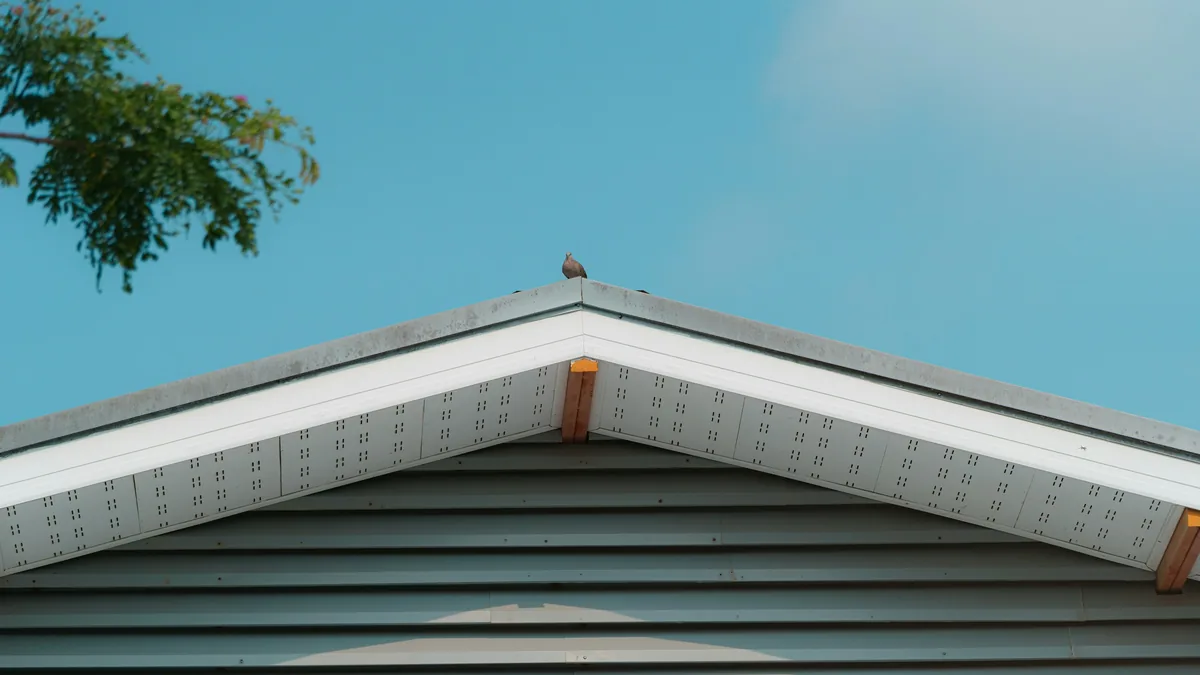
When people picture new siding, they picture the walls. But a siding job runs right up to the underside of the roof, and that is where the soffit and fascia live. These two parts frame the top of every wall, protect the roof edge and help the attic breathe. Leaving tired ones in place beside fresh siding is a bit like hanging new curtains on a peeling window frame.
What the soffit and fascia are
The fascia is the board that runs along the edge of the roof, facing outward. Gutters usually hang from it, and it covers the ends of the rafters or trusses. The soffit is the panel on the underside of the overhang, closing the gap between the fascia and the wall.
Together they finish the roof edge and keep rain, insects, birds and small animals out of the roof structure. A vented soffit also lets outside air flow up into the attic, which is part of how the attic stays drier and less hot.
Why they come up during a siding job
The top course of siding has to finish neatly against the soffit, usually with a trim piece or channel. If the soffit is sagging, rotted or about to be replaced, it makes sense to do it before the new siding is fitted against it, not after.
Fascia comes into it for a similar reason. Once a crew is up at the roof edge with ladders and staging, checking and fixing the fascia costs far less than bringing everyone back later. Doing them together also means the trim colors are chosen as one set, so the roof edge and walls match.
Signs the soffit and fascia need work
Most problems are easy to spot from the ground or a short ladder.
- Paint peeling or blistering on the fascia, especially behind gutters
- Soft, dark or crumbling wood at fascia corners and board ends
- Gutters pulling away or sagging between hangers
- Soffit panels drooping, cracked or missing
- Stains on the soffit that point to a roof or gutter leak above
- Signs of birds, rodents or bees getting into the overhang
Materials for each
Wood fascia is still common on older homes. It can be repaired and painted, but in a wet, sunny climate it needs regular attention. Many owners have it wrapped in aluminum or replaced with a composite or fiber cement board that does not rot.
Soffits come in vinyl, aluminum and fiber cement, in solid and vented styles. Vinyl and aluminum are light and easy to keep clean. Fiber cement soffit pairs naturally with fiber cement siding and takes paint the same way. Whatever you choose, it should match the durability of the siding below it, so the roof edge does not become the weak spot.
Repair a section or replace the run
A short length of rotted fascia at one corner can often be cut out and replaced with a matching board, then primed and painted. That is a sensible repair when the rest of the run is sound. When rot shows up at several corners, or the gutters have been leaking along a whole side for years, the boards beside the visible damage are usually soft too. Replacing the full run on that side gives a straight edge for the gutters and one continuous finish.
Soffits follow the same logic. A few cracked panels can be swapped out. A whole overhang that sags or has been chewed through by animals is better redone, with the framing behind it checked first.
Keeping the attic ventilation right
Vented soffits are usually the intake half of an attic ventilation system, with vents near the ridge or on the roof letting air out. When soffits are replaced, the new panels have to keep at least the same open area, and nothing should block the air path above them. Insulation stuffed into the eaves or solid panels where vented ones used to be can leave the attic hotter and damper than before.
Holding up in strong wind
Soffit panels sit right where wind wraps around a house, and loose ones can be pulled away in a storm, opening the attic to rain. That is one reason the fastening and the support behind each panel matter as much as the panel itself. In Broward and Miami-Dade, which are inside the high-velocity hurricane zone, soffit products and their installation have to meet the same demanding wind requirements as the rest of the exterior.
The rest of the trim
The roof edge is not the only trim that goes with siding. Corner boards, window and door surrounds, frieze boards and the small blocks around lights, outlets and vents all frame the new walls. Old trim that is split or rotted will look worse beside fresh siding, and gaps around it are where water gets behind the wall. A good estimate lists which trim is being replaced, which is being kept and how the joints will be sealed.
Planning the work in West Park
If you live in West Park and the roof edge is looking tired, it is worth having the soffit and fascia checked at the same time as the walls. Our siding contractor page for West Park covers local service, and the siding installation page explains how new siding and its trim come together.