
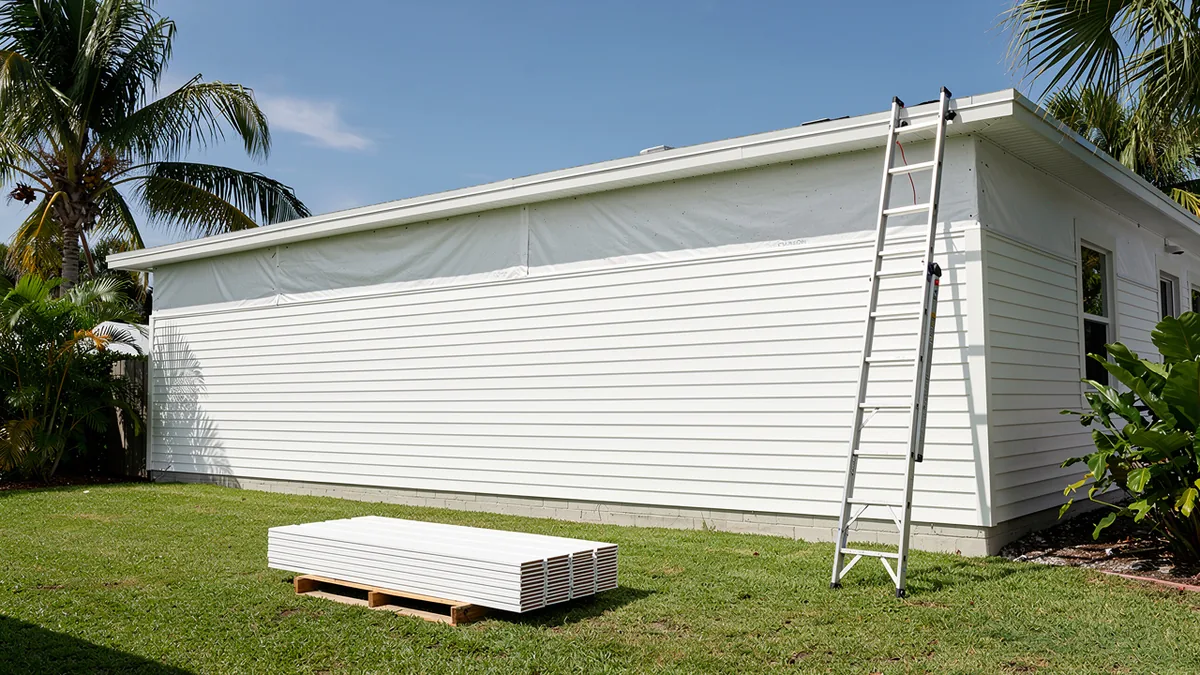
Homeowners usually ask how long the crew will be at the house. That part is often the shortest piece of the timeline. A siding project runs from the first measurement through ordering, permits, the work itself and the final inspection. Knowing which parts take time, and which ones tend to slip, makes it much easier to plan around the job and to judge whether a quoted schedule is realistic.
The timeline in four stages
Every siding project moves through roughly the same stages, though how long each one takes varies from house to house and from city to city.
- Planning: measuring, choosing the material and color, and agreeing the scope
- Paperwork and ordering: permits, any association approval, and getting the material delivered
- Work on the house: removal, repairs, water barrier, siding and trim
- Wrap-up: final inspection, clean-up and any painting that has to cure
Before anyone touches the walls
The planning stage moves at your pace. Comparing materials, looking at samples on the house and settling on a color can take a weekend or a month. It is time well spent, because changing your mind after material has been ordered is one of the easiest ways to lose weeks.
Paperwork moves at someone else's. Re-siding work generally needs a building permit, and review times depend on the city or county and how busy its building department is. Homes in a community with a homeowners' association may also need the association's sign-off on color and style before work starts. Material lead times vary too. Common profiles and colors are often in stock, while special-order colors, premium profiles or factory-finished boards can take longer to arrive.
Days on the wall: what changes the count
Once work starts, the length of the job mostly comes down to how much wall there is and how complicated it is. A small single-story house with simple walls and vinyl siding is the quick end of the range, often a matter of days. A larger home, a second story, many windows, bump-outs and corners, or a heavier material all add time.
Fiber cement usually takes longer than vinyl. The boards are heavier, they are cut with dust-control equipment, and every cut edge and joint needs attention. If the boards are painted on site rather than factory-finished, painting and drying add more days at the end.
Tear-off and hidden repairs
Removing the old siding is usually quick. What it reveals is not always. Rotted sheathing under windows, soft wall plates or damaged trim have to be repaired before the new water barrier goes on, and a larger repair may need an inspection of its own before the wall is closed up again. This is the most common reason a job runs longer than planned, and it is one more reason to have a clear agreement on how hidden repairs are handled.
Weather in South Florida
Afternoon thunderstorms are a normal part of summer here, and they shape the work day. Crews often start early and avoid leaving walls open with no water barrier when storms are coming in. A run of rainy days, or a tropical system passing nearby, can pause the job entirely. Strong wind also makes it unsafe to handle long boards on ladders. None of this damages the project if the walls are protected properly, but it does move the finish date.
Inspections and finishing
Depending on the jurisdiction, an inspector may check the work partway through and again at the end. Scheduling those visits can add a day or two between stages. After the final inspection, the remaining items are usually small ones: caulking, touch-up, replacing fixtures and a final sweep for nails and debris.
Living at home while the work goes on
Most families stay in the house during a siding job, and that is usually fine. Expect noise during working hours, from removal, cutting and nailing, and expect the crew to work on one or two walls at a time rather than the whole house at once. Windows on the wall being worked on are best kept closed, both for dust and so screens and blinds are not in the way.
If anyone at home works from a room against an exterior wall, it helps to ask which walls are planned for which days. A crew can often order the walls so the noisiest work lands where it disturbs the household least.
How to keep your job on schedule
A few things on the homeowner's side save real time.
- Make material and color decisions early and stick with them
- Clear patio furniture, grills and planters away from the walls
- Trim shrubs and branches that press against the house
- Keep driveway space free for deliveries and a dumpster
- Plan for pets and children while ladders and debris are around
Getting a realistic schedule
A fair estimate gives you an expected start window and an approximate number of working days, and says plainly what could extend them. The siding installation page explains the work itself and what is included. If you are in Dania Beach or close to it, the siding contractor page for Dania Beach covers local service, and our guide to what drives the cost of siding a single-story home explains the pricing side of the same decisions.