Wood siding has a hard life in South Florida. It sits in humid air most of the year, takes heavy summer rain, bakes in strong sun and offers termites a meal. Fiber cement is often suggested as the answer. For most homes here it is a strong choice, but it performs well only when it is installed for the climate. Here is how it holds up to each of the conditions that wear siding down.
What fiber cement is made of
Fiber cement boards are a mix of Portland cement, sand, water and cellulose fibers, pressed and cured into planks, panels and trim. James Hardie, the best-known maker, lists those same basic ingredients for its siding.
The cement and sand give the boards their weight and stiffness. The cellulose fibers hold the board together and stop it from being brittle. That small amount of wood fiber is also why fiber cement still needs to be kept from soaking up water at its edges.
Heat and strong sun
Fiber cement barely changes size with temperature, so it does not ripple or sag on a hot west wall. That stability is also why paint lasts longer on it than on wood, which swells and shrinks with every change in moisture and pushes the paint film loose.
The finish is the part the sun attacks. Factory-baked finishes generally hold their color longer than paint applied on site, and lighter colors absorb less heat. Expect a repaint eventually either way, much later than on wood.
Humidity and heavy rain
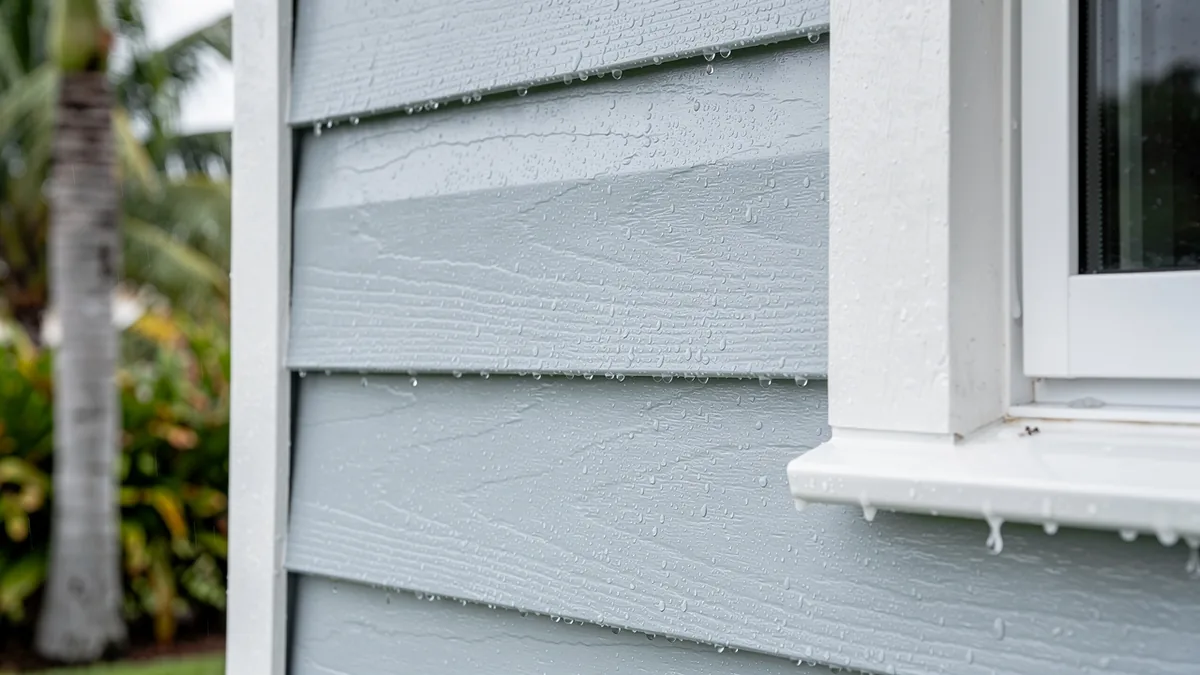
Unlike wood, a sound fiber cement board does not rot, and it does not feed mildew the way bare or poorly painted wood can. Mildew can still grow on dirt sitting on any painted surface, but it washes off.
Water becomes a problem only where the installation lets it. Cut ends that are not sealed or primed, boards run down into soil or mulch, or siding butted tight against a roof surface can wick water and swell at the edges. Manufacturers set clearances above the ground and roof for exactly this reason, and a correctly lapped house wrap and flashing behind the boards handle whatever gets past them.
Termites
Termites live on cellulose, and fiber cement offers them nothing worth eating. Swapping wood siding and trim for fiber cement removes a food source from the outside of the wall.
It does not make a house termite-proof. Subterranean termites can still build mud tubes up a wall to reach framing, which is why the University of Florida's extension service recommends keeping an inspection space of at least 6 inches between the bottom of the siding and the soil or mulch line. That gap lets anyone walking the house spot tubes early.
Hurricane winds
Weight works in fiber cement's favour in a storm. The boards are heavy and stiff, and they are fastened firmly into the wall rather than hung loose. Some building codes in high-wind areas require boards to be nailed through the face instead of only through the hidden top edge, and the manufacturer's instructions say which fasteners, spacing and nailing pattern meet a given wind load.
In Broward and Miami-Dade, the product also needs an approval for use in the High-Velocity Hurricane Zone, and the installation has to match what that approval describes.
Formulations made for the climate
Not every fiber cement product is the same. James Hardie, for example, sells a climate zone system in which its HZ10 line is formulated for hot, humid, hurricane-prone regions and its HZ5 line for cold ones. When you compare quotes, check that the product named is the one sold for this region.
Where fiber cement asks more of you
It is not the right answer for every house or budget. The main trade-offs:
- It costs more to buy and install than vinyl, mostly because it is heavier and slower to cut and fasten.
- Cutting creates fine dust, so it needs proper saws and dust control.
- Painted boards will need repainting at some point, even if far less often than wood.
- Precision matters. Gaps, flashing and clearances done wrong cause most of the problems people blame on the material.
How it compares with the wood it replaces
Against wood, fiber cement wins on almost every point that matters here: no rot in sound boards, no termite food, longer paint life and better stability in the heat. Wood still has its fans for its look and ease of repair, but in a hot, wet, termite-heavy climate it needs constant upkeep to stay sound.
If you are weighing fiber cement against vinyl rather than wood, our fiber cement and vinyl comparison covers that choice.
Is it right for your home?
For most block and frame homes in the area, fiber cement is a sound choice as long as it goes on with the right fasteners, clearances and flashing. Our fiber cement siding installation page covers the process and typical costs. If you live near the coast in Dania Beach, the Dania Beach siding page looks at local conditions there.